 Battery Testing
Checking the Battery
The battery condition is critical to the operation of the car as many functions - ignition, steering, sliding doors, air conditioning all rely on the battery being up to scratch. The negative is connected to earth.
Note also that a faulty alternator can flash up fault messages on the multiscreen.
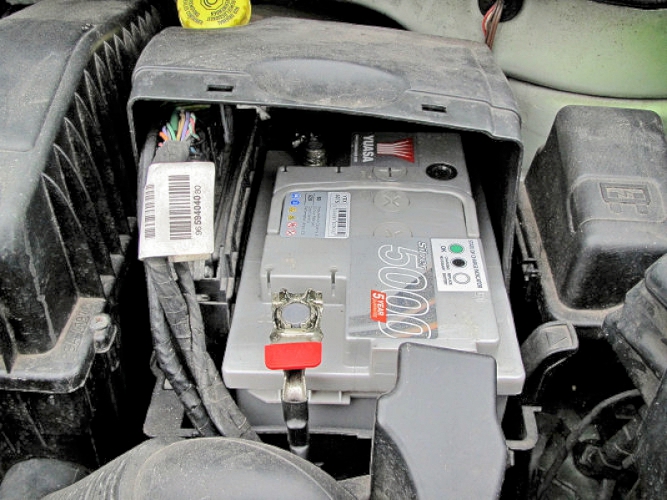
A battery can go flat in a short time if it has gone low capacity or there is a discharge through a fault on the car.
On all three of my 1007's (2 x 1.4 Dolce and 1.6 Sport) I found that initially there was a discharge of 1.6amps after switching everything off - this dropped to 15-20mA after 30 seconds or so - enough to drive the essential circuits. The battery should last for several weeks without use at this discharge rate.
Putting some figures to it: the battery discharge when the car is not in use should be around 20mA = 0.02A. This is just enough to keep the security module operational.
At this rate, a 60 amp-hour battery should last for 60/0.02 = 3,000 hours to run flat. But we don't ever want that so after 1,500 hours it will be only half discharged; which is acceptable.
1,500 hours is 62 days or 2 months. So a good battery should safely last 2+ months without any need to charge it - and indeed mine often stand for over a month without being used or charged.
So if your battery "goes flat over Christmas" then it has lost capacity and is well past its scrap-by date and should be changed for several reasons -
- it has seriously lost capacity
- modern batteries do not survive deep discharge
- it puts an abnormal load on the alternator
- a jump start on a flat battery can produce spikes on the 12 volt rail that can damage the electronics
So - consider a battery as a consumable, like tyres. You wouldn't run your tyres below the safe depth would you? - so why run the battery beyond its capabilities?
I treat batteries as replaceable items so rarely allow them to go over 5 years. If a cell has got weak then it can upset the charging circuit and flash up an alarm or cause problems with vital parts of the electronics.
Basic battery/alternator check
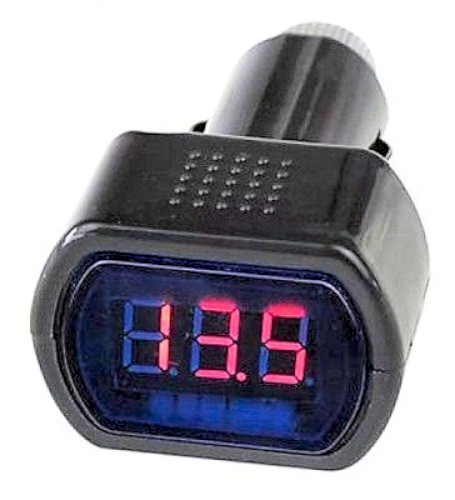
although I have sophisticated test gear, I use a car 12v battery voltmeter in the cigarette lighter socket like this for a quick check. It should indicate around 12.3 volts with engine off - rising to around 14.3 volts with the engine running.
* Using a minimum-reading voltmeter the battery volts dropped to 11.4 volts, as to be expected, when the starter was operated on an almost-new silver-cadmium battery.
To test a battery properly needs a drop tester, (see below) but not everyone will own one of these. This is a simple one Gunson Tools G4184 although it will only test up to 100amps.
If the voltages are OK (12.3 and 14.3 approx) then you could also try leaving the headlights on for a while (engine off). That would take about 10 amps out of the battery which any good battery should do easily (monitor the volts and if they drop below 11 volts discontinue the test). Have a battery charger or jump leads handy though!
The best test is a drop test which places a heavy load on the battery for about 15 seconds and checks the drop in battery voltage.
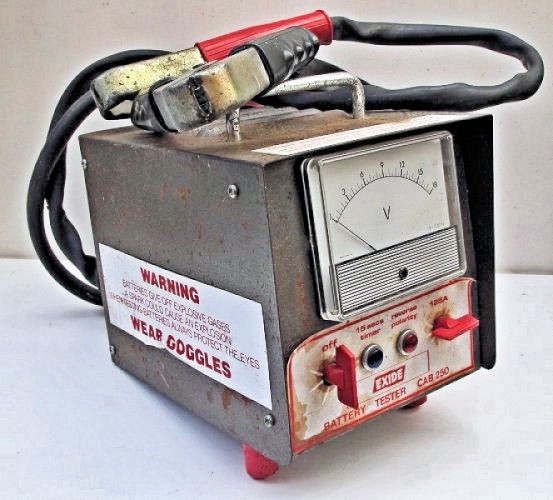
To carry out a CCA pass/fail test, you should load a fully charged starter battery with half the rated CCA value for 15 seconds. To pass, the voltage must stay above 9.6V at 10°C (50°F) and higher. Colder temperatures will cause a larger voltage drop.
* On the 1.6 Sport I found the battery would deliver 125amps and drop to 10.3 volts. At 250amps this dropped to 10.0 volts so passed the test. * 2 years later this battery was changed as it failed a drop test.
** However the battery on the 1.4 Dolce, (which appeared to be an original 2004/5 Varta battery so 7/8 years old) dropped to 9.6 volts at 125 amps but went right down to 7.0 volts at 250 amps which is well below acceptable. * 2½ years later this battery was changed again under warranty as the drop test showed just 7 volts.
Maximum battery size is 240mm long by 170mm wide by 190mm high. +ve terminal to the right.
I bought a 075 Numax Premium 60AH CCA=525 which appears to be perfectly adequate for the 1.4 manuals
and Yuasa YBX5075 High Performance Battery: 12V 60Ah CCA: 620 A Silver for the 1.6 auto
Changing the Battery. WARNING! see the next section
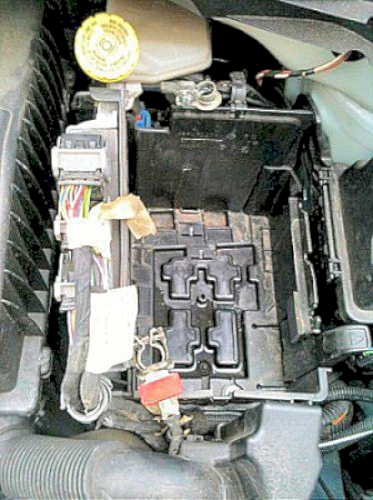
Under the bonnet, the battery is revealed by simply pulling up on the front and then rear covers. Reseat them carefully on replacing (use a torch to ensure the clever side clips locate!)
WARNING! - see below for the correct way to disconnect and reconnect the battery
To disconnect the battery:
- Before disconnecting the battery, turn off all gadgets and lights, close all the doors (DO NOT LOCK) and unplug any diagnostic tool. The drivers side window has to be kept open for access to the ignition key.
- Turn off the ignition and take out the key.
- After an interval of 3 minutes the battery can be disconnected
The BSI needs to go into Sleep mode or Economy mode, during which nothing in the vehicle should be operating. The bonnet should be opened and left up before allowing the BSI to go to Sleep Mode.
Removing the Battery
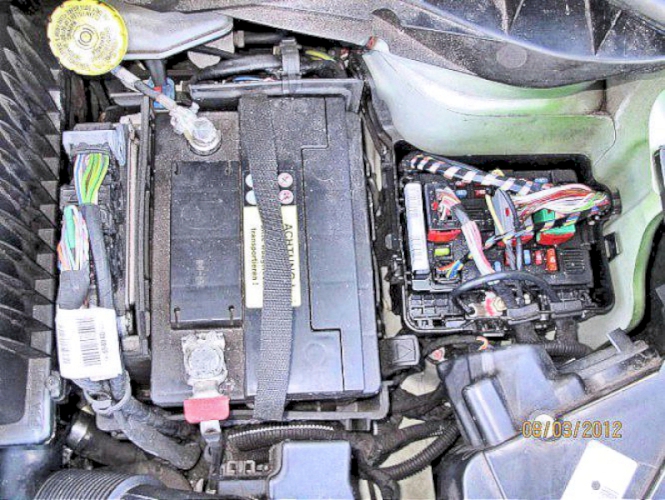
After disconnecting the battery terminals, remove the battery by first sliding the circuit board to the left of the photo upwards and out (no need to disconnect) and lay on top of the engine.
Then push the plastic catch on the right and tilt the battery to remove it.
Not the obvious solution...! (shown here with the fusebox cover removed; not necessary when changing batteries)
To reconnect the battery
Use the following procedure for reconnecting the battery unless told otherwise by Peugeot or Product service. Failure to follow this procedure may result in damage to the BSI's embedded software during reconnection.
- All the doors have to be closed with the ignition key turned off and the key taken out.
- Now without opening the doors, reconnect the battery and wait for 10 seconds.
- Turn on the headlights, you may hear a bleep.
- Open the door (may need a door reset)
- turn on the engine and check everything is working.
Some garages clip a temporary battery across the terminals which saves messing about resetting the clock
WARNING: If you disconnect your battery leave the doors unlocked and the windows open
Do not open the bonnet, lock the doors and take the battery out because if you (or some helpful assistant) then closes the bonnet there is no way of opening the doors or tailgate.
The only way out of this situation will involve grovelling under the car as follows:
- All modern cars are negative earth, so using jump leads, connect negative of battery onto a chassis point (or somewhere on the engine)
- The harder bit is to find the live connection on the end of the starter motor - you will need to grovel underneath and find this. As you only need to unlock the doors initially, you won't need heavy wire
- Once into the car, open the bonnet and fit the new battery - wait a while for it to settle and you should be OK. See above for the precautions before rushing to start it !
- Resolve never to do it again