 |
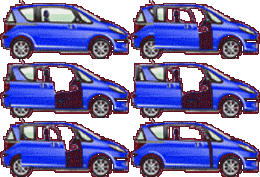
SLIDING DOORS |
|
One or two are finding the sliding door CABLES locking up so the door can't be moved at all
Has anyone experience of what actually happens? - theoretically it should be possible to dismantle (big job) and clear a mechanical problem if the cable is just out of its guides?
Try to avoid EVER operating the doors manually as it COULD stretch the cables and MIGHT cause the slack to jam on the motor drum. This includes garage mechanics!
Some people are having problems with the electric doors of the 1007, however there are some easy fixes that may cure the problems:

This is an overall drawing of the door; drawings of the important mechanical bits are below.
It is important to keep the door contacts clean.
Check upper and lower door runners for stones, damage, foreign bodies and remove as required.
I have cured a light rattle from the doors by applying silicone grease to all the locating tangs - I make it four at the front of the door and one at the back low down. Also lightly grease the door locking catch which is at the BACK of the door.
I think this is the way the sliding doors work:
When you send a signal to OPEN the door, the actuator in the door (the one which often fails) pulls (via a cable inside the door) to release the rear latch. There is an electrical contact (either on the rear latch or on the multi-contact at the front of the doors) which tells the control unit it has released. The Control Unit then tells the main door motor to open the door.
The actuator in the body (the rear latching loop) also extends ready for the final pull-in action when the door is closed (you can see this from inside the car). So you should hear TWO actuators working when the door opens.
To CLOSE the door, the main door motor is operated until the multi-contacts on the front of the door make. When the door is almost closed, the mechanical latch at the back of the door latches on to the rear actuator in the body (in a similar manner to the way a normal car door latch works).
I don't think the in-door actuator does anything at this time however the multi-contacts tell the Control Unit that the door is almost closed and activate the rear actuator in the body which then pulls the back of the door in.
Doors bouncing and coming right back at you:

There is a small switch that the lower door runners operate when the doors are fully open. It is located at the end of the bottom rail and is covered by a piece of flexible or pivoted plastic that can break and prevent the door operating the "off" switch.

One owner has found the spring loaded pad on the lower door runner stuck in the withdrawn position (and therefore not operating the limit switch). Cleared by a shot of WD40 and giving it a waggle.

Poor picture taken with door partly open, between body and door, looking back - to show position of the curved plastic piece over the switch. This pivots and flexes to operate the switch every time the door is opened.

It appears to be part #6 on the drawing - both sides the same part - Peugeot part 9137F1 "Headlamp Cover" (must be something lost in the translation)

and this is the (very small) switch itself - Item 5 on the drawing Peugeot 6559C6 left; 6559P9 right

Chances are that if it is clicking it won't need replacing - to me it looks a bit awkward and mucky to get at!
Door/s open then close immediately either from the internal buttons or the remote: (Peugeot door reset procedure)
This happens when something has restricted the motion of one of the doors and requires a reset to correct:
1. Turn on the ignition and start the engine. Make sure the gearbox in in neutral.
2. Fully open both doors by hand. The doors are quite heavy and require a good tug but will move the whole length of the runners until a definite 'stop' is felt.
3. Fully close both doors by hand, again they are quite heavy but can be closed up until the contacts connect.
4. Turn off ignition and turn it back on again. Now operate the internal door switches - all should operate normally.
Important note on the passenger door in the UK: (presumably the drivers door on LHD models?)

There is a magnetic switch on the fuel cap door that sometimes fails which stops the passenger door working. The switch is designed to stop a passenger getting out of the car during re-fuelling as the door could open onto the fuel nozzle.

Looking up from underneath the wing after removing the fibre splashguard, the switch is mounted on the side of the fuel inlet and flap assembly
If this switch malfunctions (can be caused during winter if frozen water cracks the switch body) then the passenger door will not operate. Moving the magnet closer to the reed switch may be all that is necessary if the switch is not broken.

Access to the switch itself is after removing the wheel and fibre splashguard.
An emergency repair can be made by connecting together the two wires in the junction under the rear passenger seat (accessed under the large circular cover). When the flap is closed, the reed switch sends an earth to the control unit.
If door wont close properly and remain closed
This is almost always a fault with the outside handle. Check that the handle has returned to the natural 'closed' position on the outside of the doors.
If the doors are usually operated from the key-fob then over a period of time the outside mechanical handle will become stiff because of a buildup of oxide on the hinge mechanism. This causes the handle to become slightly stiffer to operate and tend to remain in the 'open' position even after you have let go of the handle. This causes the doors to close then re-open again.
To fix this, check that the handles have returned to the 'closed' position after use or spray with WD40 penetrating oil from time to time to reduce the oxide build up.
Inside the door there is a complex set of Bowden cables to operate the locks:

This shows the assemblies dismantled from the door.

This is the internal door handle mechanism - the internal handle is underneath in this picture. The actuator is top left and operates all the cables.
The electrically operated actuator:

A number have reported a failure of this actuator. It is possible to take the door panel off both doors and swap the actuator from the drivers side to the passenger side to check if it is faulty.
The actuator is item 21 on the drawing; Peugeot part number is 661536

shows the wiring schematic - only two connections to the actuator so easy to check for 12 volts

shows the wiring harness (yellow) within the door.

this is of an actuator accidentally damaged when the mechanism was iced up - the links are still connected but out of line.

this shows the insides of an actuator - seems rather complicated and can fail if too much force applied via the INSIDE door handle.
To access and replace the actuator: information courtesy of Godfrey Grainger - or see excellent .pdf here
First - remove the door liner.
1. use a fine screwdriver to remove the plastic facia behind the internal door handle – this reveals three Pan Head screws.
2. Remove the two Pan Head screws retaining the door liner.
3. With door partly open, carefully unclip the liner from the door (start from the bottom – the top of the liner is hooked over the internal door skin).
4. to get the liner off it is then necessary to close the door and lift the liner off the top lip; then partially reopen door and the liner will lift away.
To remove the Actuator
1. Remove the electrical plug from the actuator.
2. Remove the remaining pan head screw thus releasing the internal door handle assembly from the door.
3. Turn over the door handle assembly (take care not to bend the Bowden Cable) revealing two self tap screws that retain the actuator.
4. Remove the screws and release the actuator.
N.B To assist in removing the actuator it is possible to separate the connecting rod and the linkage which clip together at 90 degrees to the axis.
Don't forget to lubricate all the many moving parts whilst the door cover is off!
In most cases, if you have to manually hold the doors closed
Press the lock button on the dash to electrically pull the doors in and lock the mechanism.
On cold mornings, spray de-icer on the windscreen and also on the door rails!
a very thin smear of silicone grease around the door seals can help the door to release easier.
Andrew has changed a motor and cable assembly:
Disconnect the battery - you don't want the motor coming alive whilst your fingers are in there!
Overall it took about 45 mins to remove 2 front seats, centre console and floor pan cover. The seats have heavy cables attached without a plug and socket, so you have to dangle a seat out of the other door then place the other seat into the vacated space. Which just makes things a bit cluttered!
It took some while getting the screws undone as they were very tight. My 18v drill/driver worked on most with a Torx bit, but others wouldn’t budge, so I borrowed one from a friend.
To swap the motor and cable assembly I needed to remove the bottom hinge from the door and support the door, remove the bottom rail and disconnect from the cable pulley, then remove that. The ends of the cable are a spring loaded ‘cup & ball’ so a screwdriver blade popped them off the hinge.
There is a triangle shaped pulley cover inside the sill with 3 nuts to remove - then the motor body has 4 nuts attaching it to the rear seat ‘wall’ - after this the whole assembly can be lifted away – feeding the cables through the large hole at the front end of the sill.
To fit the new motor body the 2 upright studs are flexible so that you can bend them forward to allow the motor body to seat itself. Reverse the whole procedure. I had difficulty stretching the 2nd cable far enough to fix it to the hinge, but later found that by closing the door with the separate 12v battery to within a foot or so, I was able to pull the cable sufficiently to do it easily. In all it took ½ an hour or so.
The following is a guess as to what should happen next:
Once all is refitted and tightened up - ensure the door will move (against the resistance of the cables and motor) to the fully open and fully closed positions. Check the cables have remained taut throughout the movements.
Reconnect the battery and start the engine - manually open the door fully - manually close the door fuily. Check electrical operation of the door has been restored.
There are many thousands of 1007's that do not give any faults at all during the ownership of the vehicle which are never reported - most people only ever talk about the bad points and fail to report on the good so please just enjoy the car - its a lot better than many others out there! Tomsov
 |
 |
 |

